
The 7th of June 2026 came and went with less noise than expected. That was the deadline for all 27 EU member states to transpose the Pay Transparency Directive into national law — and most of them missed it. Only Italy, Slovakia, Lithuania, and Malta had complete legislation in force on the day. The Netherlands and Denmark have pushed to January 2027. Sweden has paused implementation altogether and is asking for the directive to be renegotiated.
It would be a mistake to read that as a reprieve. The European Commission has refused to extend the deadline and has signaled that infringement proceedings against late states may follow. Public-sector employees can already invoke the directive directly against state employers. National courts must interpret existing equal pay law in conformity with it. And the detail that matters most to anyone who works with compensation data: the first gender pay gap reports, due in 2027, will be built from 2026 pay data. The numbers running through payroll right now are the numbers that will be reported.
The deadline passed quietly. The data did not.
What the Directive Actually Requires
The directive reaches the full life cycle of employment, not just an annual report. Candidates must be told the pay or pay range before the interview, and employers may no longer ask about salary history. Pay secrecy clauses are prohibited. Any worker can request the average pay levels, broken down by sex, for colleagues doing the same work or work of equal value.
Then comes the reporting. Employers with 250 or more employees report their gender pay gaps annually beginning in 2027; those with 150 to 249 report every three years. The figures include mean and median gaps, variable pay such as bonuses, and the distribution of men and women across pay quartiles. And the directive has teeth: where a gap of five percent or more in any category of workers cannot be justified by objective, gender-neutral criteria and goes unaddressed for six months, the employer must conduct a joint pay assessment with workers’ representatives. Once a worker establishes a prima facie case, the burden of proof shifts to the employer — and back-pay claims can reach back years.
Every One of Those Requirements Is a Statistical Question
Read that list again as an expert witness reads it. “Work of equal value” is a comparator-construction problem. “Categories of workers” determines which employees get averaged together — and grouping decisions can create or erase a reported gap. “Objective, gender-neutral criteria” is a question about which control variables legitimately explain pay differences and which do not. The five percent trigger is a bright statistical line drawn through data most organizations have never analyzed in the way the directive assumes.
This is the distinction between a raw gap and an adjusted gap, and it is about to matter enormously. The figures employers must report are, in essence, raw gaps within worker categories. The defense of those figures — to workers’ representatives, labour inspectorates, equality bodies, and eventually courts — is an adjusted analysis: employees performing substantially similar work, compared with controls for role, level, tenure, geography, and performance, with every modeling decision documented. A reported gap is a headline. An adjusted analysis is an explanation. Organizations that possess only the first will be arguing from a position of weakness.
The Same Wind Is Blowing in the United States
American employers watching this from across the Atlantic should not feel like spectators. California already requires pay data reporting. Illinois requires equal pay registration certificates. Virginia’s law requiring pay ranges in every job posting took effect on July 1 of this year, and New York City has voted to require annual pay data reporting for larger employers. The instruments differ; the direction does not. Compensation data that once lived quietly in HR systems is being pulled into public and regulatory view, jurisdiction by jurisdiction.
The common thread on both continents is simple: every disclosure is a potential exhibit. Once a pay figure is reported, posted, or handed to an employee on request, someone else can run their own numbers on it.
What Prudent Organizations Are Doing Now
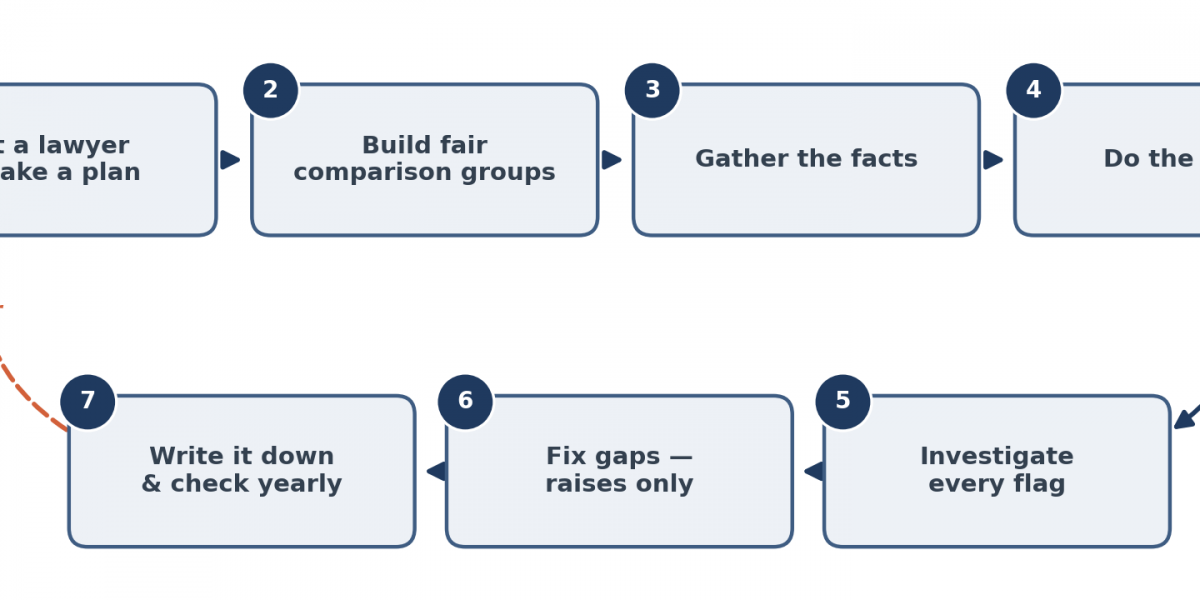
The organizations best positioned for this era are those whose pay differences have been analyzed — and can be explained — before anyone else does the analyzing. In practice, that means a privileged pay equity audit conducted at the direction of counsel before the first mandatory disclosure; a job architecture that can withstand a “work of equal value” challenge; documentation of the legitimate factors that drive pay decisions; and remediation, where warranted, on the organization’s own timeline rather than a regulator’s.
It also means treating 2026 as what it is: the base year of the record. When a joint pay assessment or an equal pay claim arrives in 2027 or 2028, the question will be what the data showed now and what the organization did about it.
Grahall provides independent pay equity analysis and expert testimony — raw and adjusted gap studies, comparator and regression work that holds up under scrutiny, and support for privileged audits at the direction of counsel, on either side of a dispute. If your organization’s numbers are about to become someone else’s evidence, it is worth knowing what they say first.
This article is general information from compensation professionals, not legal advice. Jurisdiction-specific obligations under the directive and its national implementations should be confirmed with counsel.
Prefer to talk it through? Book a 30-minute conflicts-check call — confidential, no obligation.
About the author: Ali Riyaz — Grahall Expert Witness Practice. Reasonable compensation and pay equity analysis, reports, and testimony. Meet the team or get in touch.